
[ad_1]

Keegan Barber/NASA
This was the second Dante Lauretta had waited for practically 20 years to see. A small robotic capsule was on the best way again to Earth with rocks scooped from an asteroid, and Lauretta was desperate to get his fingers on the samples.
Led by Lauretta, scientists fastidiously designed the billion-dollar mission to convey dwelling items of a carbon-rich asteroid thought to comprise natural molecules, the constructing blocks crucial for all times to take maintain. This NASA mission, identified by the acronym OSIRIS-REx, launched from Earth in 2016, collected samples from a roughly 1,600-foot-wide (500-meter) asteroid named Bennu in 2020, then set a course for return to Earth.
On September 24, the OSIRIS-REx spacecraft launched the canister containing the asteroid samples to plunge into the Earth’s ambiance, whereas the mothership steered onto a course to take it safely again into deep area for a follow-up mission to discover a special asteroid on the finish of the 2020s.
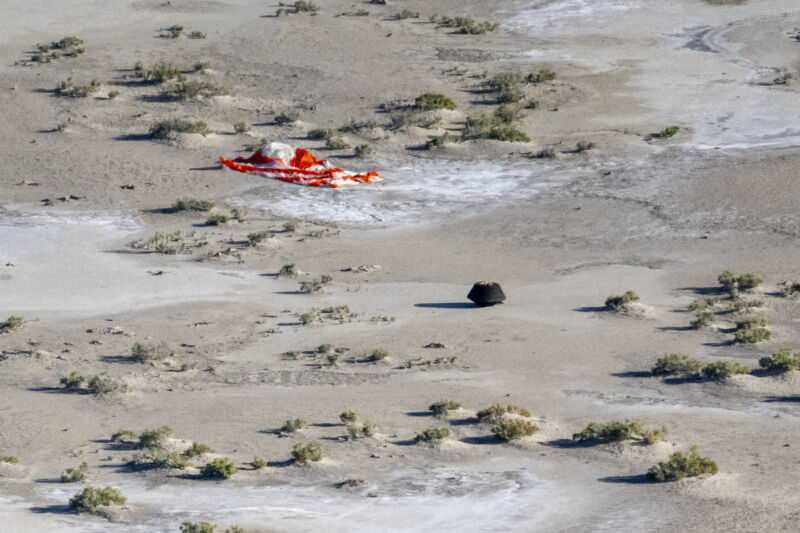
Lauretta, OSIRIS-REx’s principal investigator from the College of Arizona, was a passenger in a US navy helicopter circling the capsule’s touchdown zone within the Utah desert. A warmth defend protected the capsule from temperatures that constructed as much as greater than 5,000° Fahrenheit throughout reentry.
Then, a small drogue parachute was imagined to open to stabilize the 32-inch-wide (81-centimeter) pattern return craft. About 5 minutes later, a bigger primary chute would open to sluggish the capsule for a delicate touchdown whereas defending the dear asteroid materials sealed inside.
At the least, that was the plan. Whereas OSIRIS-REx safely returned its asteroid pattern to Earth, there have been moments of excessive drama.
Out of order
For these watching NASA’s reside video protection of the OSIRIS-REx mission’s return to Earth, there have been hints that one thing was amiss. Video imagery from a NASA monitoring airplane confirmed the capsule tumbling towards the bottom at excessive pace, effectively after the purpose when the drogue parachute ought to have been seen.
Inside a close-by helicopter, Lauretta was ready for verbal updates on the standing of the capsule.
“I heard the 100,000-foot crossing, and no drogue, and the drogue chute is meant to return out at 100,000 ft,” he recalled throughout a presentation final month to the Nationwide Academies’ Area Research Board. “Sixty-thousand ft, no drogue. I’m like, ‘Ugh, this isn’t good.’”
The final time NASA tried to convey extraterrestrial samples again to Earth, the parachute by no means opened. The robotic Genesis mission ended with an uncontrolled affect in Utah, rupturing the capsule bringing again microscopic particles collected from the photo voltaic wind. Scientists had been capable of salvage a number of the specimens, however it wasn’t straightforward.
Lauretta known as a crash just like the one skilled by NASA’s Genesis mission because the “worst-case situation” for OSIRIS-REx. In that occasion, scientists would want to scramble to assemble as a lot of the asteroid pattern as potential from the Utah desert. Something salvaged would should be fastidiously checked for contamination from Earth’s soils and life-forms.
You’ll be able to watch a replay of OSIRIS-REx’s touchdown beneath.
“We’re tumbling. We’re in a subsonic regime, and we aren’t stabilized,” Lauretta stated. “There’s no drogue chute deployed right here. Drawback! So I used to be like attempting to mentally put together myself, as a result of we’re on reside TV, to get off this helicopter and take care of a crashed capsule within the desert.”
Then, Lauretta heard affirmation from the Air Drive that the OSIRIS-REx return capsule had unfurled its primary parachute.
“I used to be like, ‘What? How is that potential?’” he stated. “So the principle chute deployed. The drogue chute, as we’ve been capable of reconstruct, went one second earlier than the principle. So it got here out. It needed to come out. It was in entrance of the principle parachute within the canister, and it seems like there was a circuit difficulty.”
NASA supplied a extra detailed description Tuesday of the issue that prevented the on-time deployment of the drogue chute.
The capsule was imagined to ship an automatic sign to deploy the drogue chute at 100,000 ft, starting a roughly five-minute timer earlier than a second sign would minimize a retention wire for the drogue, permitting the bigger parachute to unfurl and full the touchdown sequence. As a substitute, at 100,000 ft, the sign triggered the system to chop the drogue free whereas it was nonetheless packed contained in the capsule, based on NASA.
At 9,000 ft, the opposite sign despatched the command to truly launch the drogue chute. However with its retention wire already minimize, the drogue instantly launched from the capsule, and the principle parachute opened as anticipated.
“The primary sign was supposed to fireplace the mortar and launch the drogue,” Lauretta stated. “The second sign was supposed to chop the cable to launch the principle … It seems like the primary sign minimize the (cable), after which the second sign fired the mortar, so it went backwards. However it labored. We had a number of margin on that primary chute. It landed safely—a lovely pinpoint touchdown within the Utah desert.”
An investigation by engineers from NASA and Lockheed Martin, which constructed the OSIRIS-REx spacecraft and pattern return car, discovered that construct plans for the mission weren’t particular sufficient in instructing technicians who assembled the return capsule.
“Within the design plans for the system, the phrase ‘primary’ was used inconsistently between the machine that sends the electrical alerts, and the machine that receives the alerts,” NASA stated in a written assertion. “On the sign aspect, ‘primary’ meant the principle parachute. In distinction, on the receiver aspect ‘primary’ was used as a reference to a pyrotechnic that fires to launch the parachute canister cowl and deploy the drogue.
“Engineers related the 2 mains, inflicting the parachute deployment actions to happen out of order,” NASA stated.
Lauretta stated scientists proceed analyzing the asteroid supplies delivered by OSIRIS-REx.
In a preliminary evaluation of a number of the mud, scientists discovered practically 5 p.c carbon by mass, and the fabric has plentiful water within the type of hydrated clay minerals. It’s extremely believable that asteroids like Bennu delivered the overwhelming majority of the water now present in Earth’s oceans, lakes, and rivers billions of years in the past.
The workforce tasked with retrieving the samples from the capsule at NASA’s Johnson Area Middle in Houston has encountered hassle opening a number of the fasteners sealing the asteroid materials in the principle assortment chamber. Whereas the workforce labored on a brand new plan to assemble all of the asteroid specimens held inside, it used tweezers to tug out a number of the largest items, together with a roughly 1.2-inch (3-centimeter) fragment straight from Bennu.
“The natural chemistry seems unbelievable,” Lauretta stated.
[ad_2]
Leave a Reply